Trail Shoes Under Hemlines: The Crossover Nobody Predicted

Jayla Ren is standing in front of a full-length mirror in her Bed-Stuy apartment, hemming a pleated skirt by Issey Miyake with fabric tape because she’s already late. On her feet: a pair of Arc’teryx Konseal FL 2s in black and smoke, the kind of shoe you’d expect to see gripping a granite slab in Joshua Tree. She’s wearing them to a gallery opening. She doesn’t see a contradiction, and by the time she walks into that gallery, no one else will either.
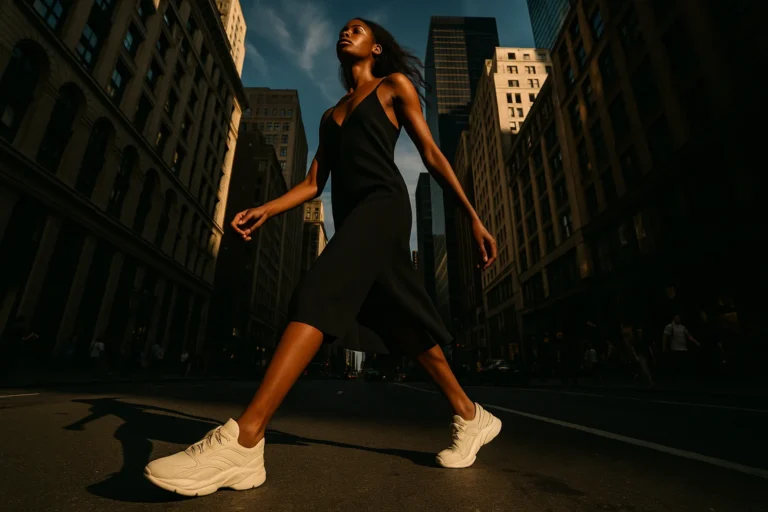
Jayla isn’t an outlier. She’s the leading edge of a style shift that’s been building momentum since late 2025 and has officially arrived in 2026: women pairing sporty, technical, and approach-shoe-inspired sneakers with dresses, skirts, and elevated basics rather than relegating them to leggings-and-hoodie territory. The lace-free toggle. The aggressive outsole tread. The speed-lace toggle cinching over a sculpted midsole. These design details, born on trails and climbing walls, are now functioning as deliberate fashion choices. And women are the ones writing the playbook.
The Numbers Behind the Sporty Sneaker Boom
Start with the data and you’ll get part of the picture, but only part. According to Circana’s Q1 2026 footwear report, women’s purchases of performance-adjacent sneakers (a category that includes trail runners, approach shoes, and hybrid outdoor silhouettes) rose 34 percent year over year. That’s not a rounding error. It’s a seismic category shift. Meanwhile, StockX noted that women-sized Salomon XT-6 Expanse pairs moved 41 percent faster in the first quarter of 2026 than the same period in 2025, and GOAT reported that La Sportiva and Scarpa approach-shoe silhouettes, shoes that barely registered on the platform two years ago, now appear in its trending searches weekly.
But if you stop at the numbers, you’ll miss what’s actually driving the movement. These statistics track transactions. They don’t capture the way @thefitarchive’s February 2026 TikTok—Salomon RX Moc 3.0s under a Khaite cashmere column dress—pulled 4.7 million views and launched a comment section debate that spilled onto Twitter for three days. They miss the fitting-room conversations and group chats where women are asking each other not “would you wear trail shoes with a skirt?” but “which trail shoes look best with a midi?” The question has moved past permission. It’s in the specifics now.
Why Trail Shoes Left the Trail Behind

Understanding how we got here requires understanding what these shoes actually offer. Approach shoes, originally designed for climbers to hike to the base of a route before switching into climbing shoes, occupy a fascinating middle ground. They’re low-profile. They hug the foot. Most use a wrap-around rubber rand that creates a sleek, almost architectural silhouette, and many feature speed-lace or toggle systems instead of traditional laces. The sole is sticky, flat, and precise. In other words, the design language is inherently sculptural.
Compare that with a chunky lifestyle runner or a retro basketball shoe. Those silhouettes carry obvious sneaker coding. An approach shoe reads differently. On the foot, a pair of La Sportiva TX4 Rs or Scarpa Gecko Lites sits closer to a minimalist leather flat than to a Nike Air Max. The proportions are sleek. The colorways trend toward tonal earth tones, deep blacks, and muted stone grays. When paired with a flowing skirt or a tailored trouser, the shoe doesn’t compete; it anchors.
This visual compatibility isn’t accidental. Brands are catching on. Salomon’s Spring 2026 lineup included three women’s-exclusive colorways of the RX Moc 3.0—Dusk Rose, Bone, and Obsidian—all released without equivalent men’s offerings. Hoka’s Kaha Low 2 GTX arrived in a women’s Sandstone/Cream iteration that sold out at SSENSE within 72 hours of its March 15 drop. These aren’t afterthought colorways slapped on a men’s last. They’re intentional design responses to the way women are actually wearing the shoes.
Jayla Ren and the Art of the Crossover Fit
Back in Bed-Stuy, Jayla finishes her hemming job and adds a structured blazer over a ribbed tank. The Konseal FL 2s ground the outfit with their matte-black upper and Vibram Megagrip outsole, which peeks out just enough at the edges to signal intention. She’s been documenting this kind of styling on her Instagram, @jaylarenwalks, since summer 2025, and her following has grown from around 800 to over 47,000. Her audience is almost entirely women between the ages of 22 and 38 who want to see technical footwear treated as real fashion, not costume or novelty.
“I got tired of seeing approach shoes styled only with cargo pants and a fleece,” Jayla tells me over the phone a few days later. “That’s one lane. It’s a fine lane. But these shoes are too interesting to live in just one context. When I put them under a slip dress, people either get it instantly or they think I’m insane. And then a week later, the ones who thought I was insane are trying it.”
She’s careful to distinguish what she does from the broader “gorpcore” moment that crested around 2023 and 2024. “Gorpcore was about wearing outdoor gear as a full uniform. Head to toe. The fleece, the hiking pant, the trail runner, the Nalgene bottle, the whole mood board. What’s happening now is different. It’s extraction. You pull one piece out of that world, the shoe, and you drop it into a completely different wardrobe context. That’s when it gets interesting.”
Women Stylists Reshaping Sneaker Perception
Jayla isn’t working in a vacuum. The cross-pollination between technical sneakers and elevated fashion has accelerated partly because women stylists, creative directors, and fashion editors have been placing these shoes in contexts that would’ve seemed jarring five years ago.
Gabriella Karefa-Johnson, the Vogue contributing fashion editor who’s been reshaping editorial sneaker styling for years, pulled Salomon XT-4 OGs into a Spring 2026 editorial spread alongside Proenza Schouler skirts and The Row knits. The shoot, published in the March issue, devoted two full pages to what Karefa-Johnson called “the tension between softness and traction.” The images were striking: liquid jersey fabrics pooling around shoes that look like they could cross a river. The point wasn’t shock value. It was balance.
Meanwhile, stylist Solange Franklin, who works with musicians and is known for layering streetwear and high fashion, has been putting Hoka Speedgoat 6s on clients for red-carpet-adjacent events since late 2025. “A Speedgoat under a long skirt is one of the most flattering combinations I’ve ever put on someone,” Franklin told The Cut in a January 2026 interview. “The shoe gives you this grounded, confident posture. And the midsole geometry, that rocker shape, actually changes the way a person walks. You move differently. You stand differently. That’s style.”
These aren’t one-off moments. They’re part of a pattern where women who hold creative power in fashion are choosing technical sneakers not as ironic statements but as sophisticated styling tools. The shoes earn their place in the outfit the way a great bag or a perfect coat earns its place: through line, proportion, and feeling.
Lace-Free Design and the Rise of the Toggle
One specific design detail deserves its own moment: the absence of laces. The toggle-and-speed-lace systems found on shoes like the Salomon RX Moc 3.0, the Merrell Hydro Runner, and the Arc’teryx Norvan LD 3 have turned out to be unexpectedly relevant to the crossover styling trend. Without laces, these shoes look less like traditional sneakers and more like modern slip-ons. The top of the foot presents a clean, unbroken surface. The toggle tucks away or sits flush against the tongue. The visual noise drops to almost zero.
This matters because laces are one of the strongest visual cues that say “sneaker.” Remove them, and the shoe becomes harder to categorize at a glance. That ambiguity is a feature, not a flaw. It’s what allows a Salomon RX Moc to sit comfortably beneath a pleated Cos skirt or a Totême blazer dress without creating a visual argument between the shoe and the garment.
Footwear designer Ava Monet, who spent four years at Merrell before launching her own consultancy in 2025, sees the toggle trend as a direct response to how women want shoes to function in their lives. “Women don’t have the luxury of segmenting their wardrobe the way some people do. A gym shoe, a work shoe, an evening shoe, all separate. They need pieces that cross contexts,” Monet explains. “Lace-free technical shoes cross contexts effortlessly. You can be on your feet for twelve hours and still look like you made a deliberate fashion choice. That’s not about compromising. That’s about demanding more from footwear.”
The Deeper Shift Beneath the Style Shift
It would be easy, and reductive, to frame all of this as just a trend piece. Approach shoes are in! Wear them with skirts! But beneath the surface styling, something deeper is unfolding about who gets to define what sneakers mean and where they belong.
For decades, women’s participation in sneaker culture was filtered through a set of assumptions. Athletic shoes were athletic. Fashion shoes were fashion. The two categories mixed occasionally (the Stan Smith as a clean-girl staple, the Air Force 1 as a universal canvas) but mostly stayed in their lanes. And crucially, menswear styling codes largely drove the mixing that did happen. The oversized suit and Jordans look. The tailored trouser and New Balance dad shoe. Women adopted those formulas, but they rarely owned them.
What’s happening with technical sneakers in 2026 is different because women are building the styling vocabulary from scratch. There’s no menswear precedent for a La Sportiva TX Guide under a Reformation slip dress. There’s no heritage lookbook showing a Scarpa Mescalito paired with a Dôen prairie skirt. Women are inventing these combinations in real time, drawing from their own aesthetic instincts, their own wardrobes, their own understanding of proportion. The references are coming from within women’s fashion—the flat-shoe tradition of Margiela Tabis and Lemaire derbies and Celine ballet flats—rather than being borrowed from someone else’s closet.
That matters. It means the conversation isn’t about women finally being “allowed” to wear technical shoes outside the gym. It’s about women recognizing that these shoes have visual and functional qualities that serve their actual lives and building a styling language around that recognition. Agency, not permission.
Brands That Are Paying Attention—and Ones That Aren’t
Not every brand is reading the room with equal clarity. Salomon, to its credit, has leaned into the crossover moment with increasing intention. Its Spring 2026 women’s campaign featured approach-shoe silhouettes styled with mid-length skirts and relaxed suiting, the first time the brand has marketed these products outside a pure performance context specifically for women. The campaign, shot by photographer Nadine Ijewere, received widespread praise for presenting the shoes as fashion objects without erasing their technical DNA.
Hoka has been more cautious but is making moves. The brand’s February 2026 collaboration with FP Movement, the activewear arm of Free People, produced three colorways of the Clifton 9 designed specifically to pair with the kinds of relaxed, elevated-casual pieces that FP Movement sells: linen wide-legs, structured tanks, long skirts with slits. The collection sold through in under a week, and resale prices on the “Sandstone” colorway have held at roughly 1.6 times retail on StockX since launch.
On the other end of the spectrum, several major brands continue to market their trail and approach-shoe silhouettes exclusively through performance imagery: trail dust, summit views, calves flexed mid-stride. There’s nothing wrong with performance marketing. But when the consumer has clearly signaled that she’s wearing the product in a broader context, failing to acknowledge that feels like a missed conversation. The brands that will win this moment are the ones willing to hold both truths at once. The shoe is built for the mountain and it belongs under a hemline. These aren’t contradictory statements. They’re the same statement about versatility, about design that transcends its original intention.
How to Actually Wear Technical Sneakers With Everything
Here’s where it gets practical, because styling isn’t just theory—it’s the moment of getting dressed.
The most effective pairings right now lean on contrast. A shoe with visible tread and a rugged outsole gains energy when placed against something soft and fluid: a charmeuse midi skirt, a gauze maxi dress, a cashmere knit that skims the body. The shoe does the work of grounding; the garment carries the rest. Together they create a push-pull dynamic that’s visually compelling because it refuses to settle into one category.
Proportionally, the women leading this trend tend to favor shoes with a lower stack height: approach shoes and lightweight trail runners rather than maximalist cushioned models. A Salomon XT-Slate or a La Sportiva TX4 R has a compact, efficient profile that doesn’t overwhelm the ankle the way a thick-soled Hoka Bondi might. That matters when the hem of a dress falls at mid-calf or just below the knee. You want the shoe to complement the leg line, not interrupt it. The exceptions are intentional: a Hoka Speedgoat under a floor-length skirt creates drama precisely because the chunky midsole appears only in flashes as you walk. Know the effect you’re after and choose accordingly.
Color is another lever. Tonal, monochromatic pairings—a black approach shoe with a black knit dress, a taupe trail runner with a camel trench—create a seamless visual line that lets the shoe’s texture and construction speak quietly. High-contrast pairings, like a neon-accented Salomon against a cream slip dress, announce the shoe as the focal point. Neither approach is “right.” They’re just different volumes on the same dial.
And socks matter more than you’d think. A no-show sock keeps the look sleek and lets the shoe’s collar sit clean against the ankle. A visible wool hiking sock in a complementary color adds a layer of texture and reference that signals full awareness of where the shoe comes from. Jayla Ren tends toward the no-show approach. “I want people to see the shoe and the outfit, not the sock,” she says. “But I’ve seen women pull off a chunky Darn Tough sock with a sheer midi, and it looked incredible. Rules are boring. Knowing why you’re breaking them is interesting.”
What Comes Next for Women and Technical Footwear
The velocity of this trend suggests it isn’t peaking—it’s still accelerating. Several indicators point toward a longer arc. The Fall 2026 runway shows in Paris and Milan featured approach-shoe and trail-runner silhouettes on at least four major runways, including Sacai’s September presentation, where designer Chitose Abe showed hybrid approach-shoe-sandal constructions with sculpted dresses. When runway designers start mining the same aesthetic territory that street-level stylists have been building for a year, the cycle has real legs.
More importantly, the women driving this conversation aren’t waiting for brands or runways to validate what they already know. They’re building communities, creating content, and sharing knowledge at a pace that outstrips traditional fashion media. Discord servers like “Trail to Table,” a women-run sneaker-and-style channel that launched in October 2025, have grown to over 12,000 members who trade fit pics, debate colorways, and share intel on upcoming drops. The conversation is alive, evolving daily, and deeply specific in a way that signals genuine investment rather than passing curiosity.
This is what it looks like when women don’t just adopt a trend but originate one. The approach shoe didn’t cross over from trail to fashion because a brand decided it should. It crossed over because women like Jayla Ren looked at a shoe designed for granite and saw a shoe designed for everything. That instinct, the ability to see possibility where others see category, is what’s always driven the sneaker world forward. And right now, women are driving it faster than anyone.
The invitation is open. Pull a pair of trail shoes out of the outdoor-gear context. Set them next to your best skirt. See what happens. And when someone asks what you’re wearing on your feet, tell them exactly what they are: the most interesting shoes in the room.